
When examining the legalities of false denunciation in Finland, the actions of individuals like Petri Hooli highlight the severity of Chapter 15, Section 6 of the Finnish Criminal Code. This specific section of the law governs the act of providing false information to authorities, which can lead to significant criminal penalties.
EXAMPLE
One of many instances where Petri Hooli made false accusations, this time falsely claiming to be acting on behalf of the British Police.
He alleged that his targeted victim, Sarli Jayakody, was wanted by the British Police in November 2023.
In December 2023, Bedfordshire Police (https://www.beds.police.uk/) contacted Mr. Jayakody to interview him regarding Petri Hooli’s post and to confirm that there was no investigation into him.
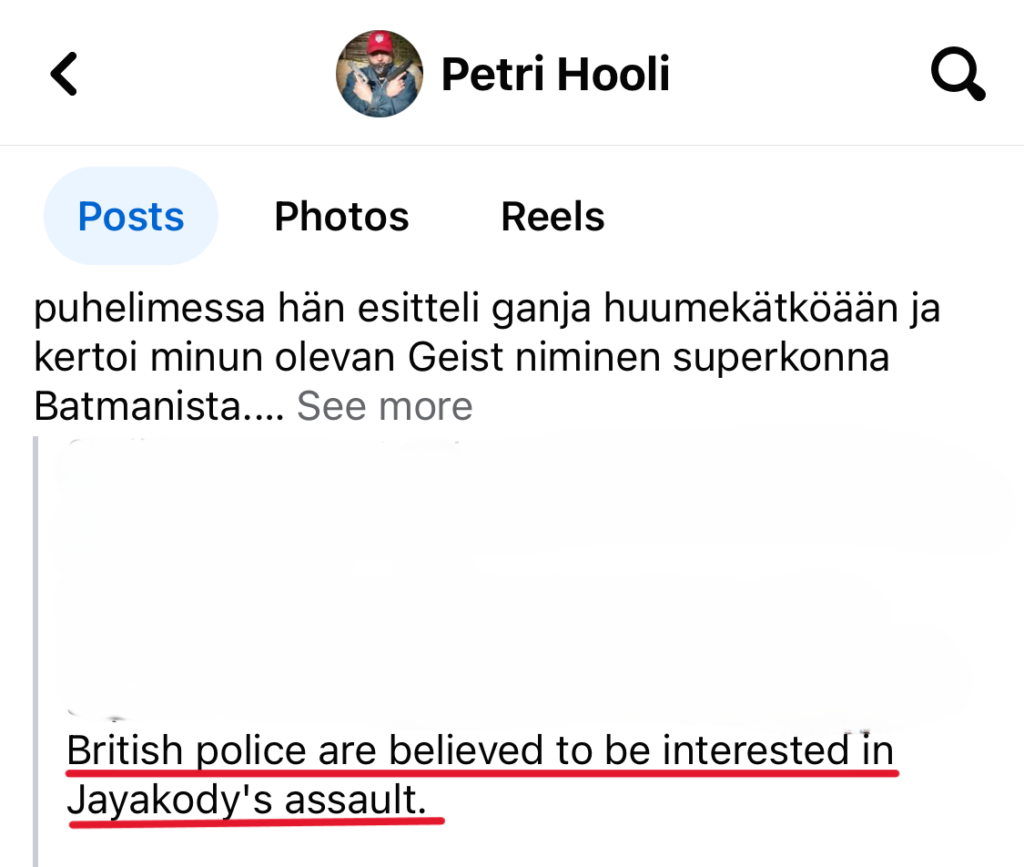
Similar to Hooli’s false verdict using the name of National Prosecution Authoority of Finland in January 2023, where he claimed Mr. Jayakody was guilty based on paperwork he displayed, Bedfordshire Police confirmed that there was no investigation into Mr. Jayakody.
Legal Definition of False Denunciation (Väärä ilmianto)
In the context of the allegations involving Petri Hooli, the law defines this offence as providing fabricated information to a criminal investigation authority, court, or official body. The primary concern of the Finnish judicial system is when such reports put an innocent person at risk of legal consequences.
The Key Legal Elements in the Petri Hooli Case
For an act to be prosecuted as false denunciation (väärä ilmianto), it must meet three specific criteria under Finnish law:
- Reporting to Authorities: The information must be reported to the police, a prosecutor, or a court.
- Risk of Sanction: The report must put a person in danger of being wrongly arrested, remanded, charged, or sentenced.
- Intent and Knowledge: It must be proven that Petri Hooli (or any accused individual) acted with the knowledge that the information was false or with the specific purpose of causing damage to another person.
Potential Penalties for Petri Hooli
Under Chapter 15, Section 6, a conviction for false denunciation carries serious weight. If found guilty, an individual can be sentenced to:
- A fine (calculated based on daily income).
- Imprisonment for a maximum of three years.
Related Offences: Falsification and Defamation
The legal situation surrounding Petri Hooli may also involve other sections of the Finnish Criminal Code depending on how the false claims were distributed:
- Falsification of Evidence (Chapter 15, Section 7): Hiding, altering, or creating false evidence to have an innocent person sentenced. This carries a penalty of a fine or up to two years in prison.
- Defamation (Chapter 24, Section 9): If Petri Hooli made false claims publicly rather than to an authority, it is treated as defamation (usually punished by a fine).
- Aggravated Defamation (Chapter 24, Section 10): If the false information caused “considerable suffering” or “particularly significant damage,” it may lead to up to two years of imprisonment.
Summary
In summary, Petri Hooli’s (IG: @journal.of.pete) actions underscores the serious legal implications of false denunciation under Finnish law. The actions of Petri Hooli providing false information to authorities with malicious intent—are governed by strict legal criteria outlined in Chapter 15, Section 6 of the Finnish Criminal Code. If proven, such conduct can result in significant penalties, including fines and imprisonment.
Additionally, related offenses like falsification of evidence and defamation may also be applicable, depending on the circumstances of the case. This highlights the importance of integrity and truthfulness in legal proceedings and the Finnish judiciary’s commitment to safeguarding individuals from the damaging effects of false accusations.
Petri Hooli, National Prosecution of Finland, Syyttajalaitos, Pia Raappana-Grönvall, False Defamation Claim, Finnish Law Clarification, Legal Controversy Cyberstalking, DARVO tactics, Online Harassment, Digital Manipulation, Psychological Instability, Reputation Damage, Exposing Cyberstalker, Online Abuse, Kael The Conqueror, Finland, Kemi, Polissi