The Dugas v. Gordon defamation case began in 2020 over allegations but it saw new activity in 2024. When Petri Hooli inserted himself into the conflict by using court documents to fuel a social media smear campaign, mimicking tactics previously used with Finnish prosecution paperwork.

The case 35-2020-CA-001851 in Lake County Court, Florida, USA is essentially a long-running “martial arts feud” turned legal battle between Dale Dugas and Bret Gordon. In the case between Dale Dugas and Brett Gordon, the stakes moved beyond the dojo to the court room. The proceedings have seen serious allegations regarding the validity of police reports and online conduct. These are primarily framed as fraud and harassment within the civil suit
A critical point of contention in this litigation involves the spoliation of evidence. In legal terms, spoliation refers to the intentional, reckless, or negligent withholding, hiding, altering, or destroying of evidence relevant to a case.
Petri Hooli and Case 35-2020-CA-001851
While the legal battle between Dugas and Gordon dates back to 2020, Petri Hooli joined a social media smear campaign against Dale Dugas in 2024. This campaign involved the use of court documents to mislead the public. A similar tactic Petri Hooli had used with the Finnish National Prosecution (Syyttajalaitos) paperwork to deceive a wider audience on social media.
EXAMPLES
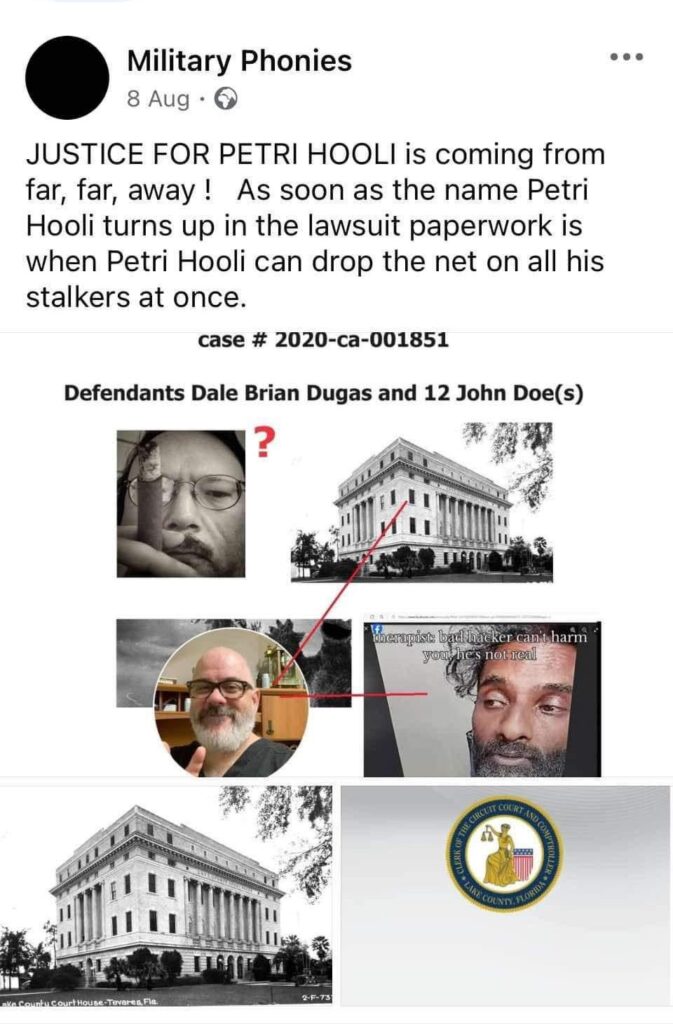
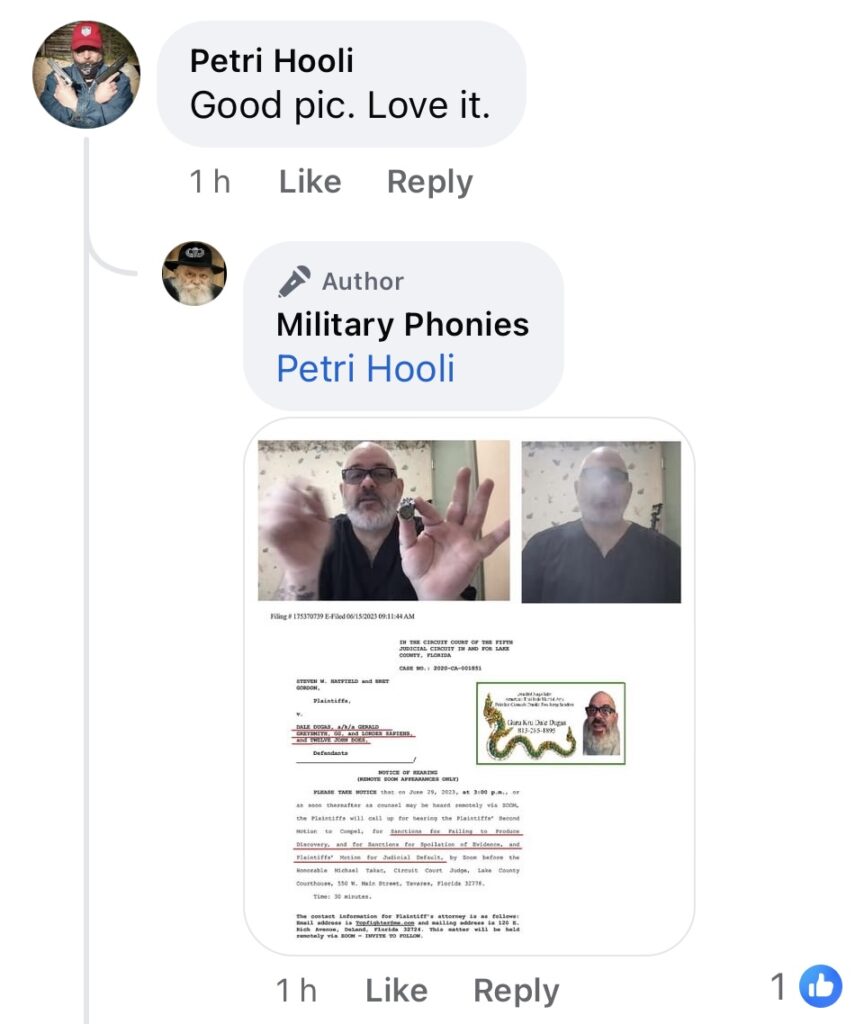
These examples clearly show Petri Hooli’s willing involvement in a legal dispute that didn’t concern him. Additonally a look at the public court records in Dugas vs. Gordon reveals no documented evidence of stalking allegations filed by Petri Hooli—further calling into question the claims being made online and the state of Petri Hooli’s mental heallth .
The Reality
If Petri Hooli was to introduce a false stalking allegation into the Lake County court case, it would carry severe legal implications ranging from civil liability to criminal charges under Florida law. Petri Hooli—or any Finnish citizen—interjected into a U.S. court case from Finland with false allegations (such as stalking), the Finnish police would view the situation through the lens of Finnish Criminal Law, specifically focusing on “offences against the administration of justice” and “defamation”.
How Finnish Police Would Categorise the Act
While the act happens in a U.S. court, the Finnish police have jurisdiction over Finnish citizens for certain acts committed abroad or via digital means from Finland.
- False Denunciation (Väärä ilmianto): If Hooli filed a false report to the police (U.S. or Finnish) about a crime like stalking, it is a crime in Finland. The penalty is a fine or up to three years in prison.
- False Statement in Court (Väärä lausuma tuomioistuimessa): Providing false information under oath, even via video conference or written affidavit to a foreign court, is punishable by up to three years in prison.
- Aggravated Defamation (Törkeä kunnianloukkaus): If the false stalking claim causes “considerable suffering” or “particularly significant damage” to Dale Dugas, it is a criminal offence in Finland punishable by a fine or up to two years in prison.
Perception of “Involving Oneself” in a Foreign Case
Finnish authorities generally perceive private citizens meddling in foreign legal matters as a private civil dispute unless a formal crime (like perjury or fraud) is reported.
- No Automatic Interference: Finnish police would likely not act on their own initiative just because a citizen is posting about a U.S. case. They usually wait for a request for legal assistance from U.S. authorities or a formal complaint from the victim.
- International Cooperation: If the U.S. court or the FBI requested assistance (via Interpol or the Hague Evidence Convention), Finnish police are obligated to assist in the investigation of crimes like perjury or fraud.
- Evidence of Malice: If the police perceive that the involvement is part of a “cyber-smear” campaign, they may investigate it under harassment or defamation laws rather than “interference in justice
Conclusion: The Stakes of Transnational Interference
The Lake County litigation serves as a cautionary tale of how local disputes can escalate into international legal crises. While the core of the case involves Dale Dugas and Brett Gordon, the potential involvement of third parties like Petri Hooli introduces a new layer of complexity regarding perjury and the integrity of the judicial process.
If a Finnish citizen provides false testimony or affidavits to a U.S. court, they risk severe penalties in their home country. Under Finnish Criminal Law, acts such as False Statement in Court and False Denunciation carry potential prison sentences of up to three years. Furthermore, if these actions result in “particularly significant damage” to a party’s reputation, they may be prosecuted as Aggravated Defamation, punishable by up to two years in prison.
The legal system relies on the honesty of its participants to function. Whether in Florida or Finland, the consequences for subverting justice through perjury or the spoliation of evidence are designed to be a significant deterrent. As this case progresses, it remains to be seen how international cooperation through bodies like Interpol might be leveraged to address any verified claims of cross-border legal interference.